When the Office Moves In: Designing a Work-From-Home Space That Doesn't Kill the Vibe
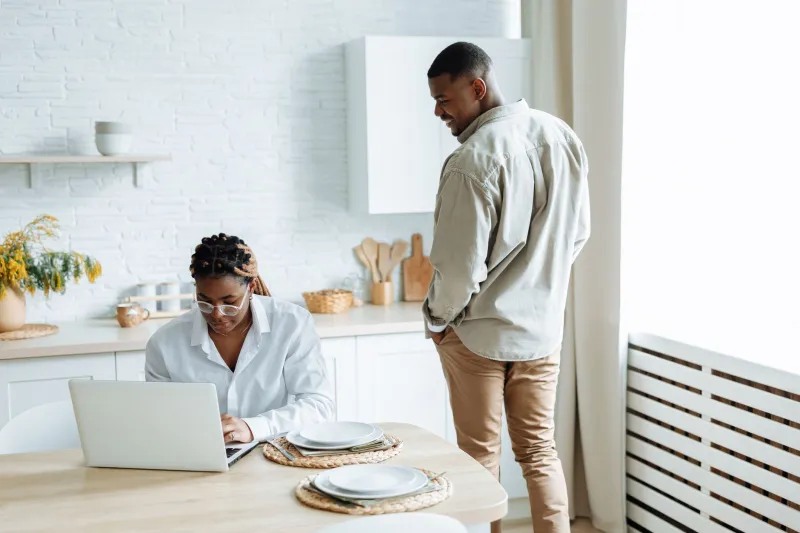
Let's be honest: nobody pictures a standing desk and a ring light when they're dreaming about their first home together. But remote work is very much a reality for millions of couples across the country, and figuring out how to share a space that has to pull double duty — professional by day, relaxing and romantic by night — is one of the trickier design puzzles newlyweds face.
The good news? It's absolutely solvable. You don't need a dedicated home office wing or a spare room collecting dust. What you do need is a little intentionality, some honest conversation, and a few smart design moves that make the space feel like yours — not just a place where someone happens to take Zoom calls.
Start With the Honest Conversation You've Been Avoiding
Before you buy a single shelving unit, sit down and talk through what "working from home" actually looks like on a daily basis. Is it a few hours a week, or is it a full eight-hour grind with back-to-back meetings? Does your partner need near-total silence, or can they function with background noise? Is there flexibility in when they work, or is the schedule pretty rigid?
These details matter more than you'd think. A freelance graphic designer who works in focused two-hour bursts has completely different spatial needs than someone who's on video calls from 8 a.m. to 5 p.m. Designing around vague assumptions leads to resentment. Designing around real information leads to a room you both actually want to be in.
Zone Without Walls
You don't need a door to create psychological separation. In fact, some of the most successful work-from-home setups in smaller homes rely entirely on visual zoning — using furniture, rugs, lighting, and color to signal "this corner is the office" without physically closing anything off.
A few approaches that work really well for couples:
Anchor the workspace with a distinct rug. A different texture or pattern under the desk area creates a subtle but effective boundary. When you're on the rug, you're at work. When you step off it, you're home.
Use a bookshelf or open shelving unit as a room divider. It maintains airflow and light while creating a soft visual barrier. Bonus: you can style it with books, plants, and meaningful objects that feel personal rather than corporate.
Try a murphy bed or fold-out desk in a guest room or multipurpose space. If you have even one room that isn't the primary bedroom or main living area, a well-designed fold-away setup can completely transform how you use it — work mode and guest mode, no full renovation required.
Differentiate lighting. A focused task lamp over the desk and warmer, ambient lighting in the rest of the room does a surprising amount of heavy lifting. When the task lamp is off, the office is closed.
The Acoustic Problem Nobody Warns You About
Sound is probably the single biggest source of friction in shared work-from-home situations, and it's also the thing couples tend to underestimate until they're already annoyed with each other.
If one of you is on calls frequently, think about:
- Soft furnishings. Rugs, curtains, upholstered furniture, and throw pillows all absorb sound. Hard floors and bare walls create echo and carry noise further. If your home feels sparse right now, adding texture isn't just an aesthetic choice — it's an acoustic one.
- White noise machines or a small fan. These are inexpensive and genuinely effective at creating a sonic buffer without requiring anyone to wear headphones all day.
- Acoustic panels that don't look like acoustic panels. The market for stylish sound-dampening wall art has exploded in the last few years. You can find panels in virtually any color or pattern that do real acoustic work while looking like intentional decor.
- Noise-canceling headphones as a household investment. Seriously. If you haven't bought a good pair yet, consider it a gift to your marriage.
Furniture That Works Harder Than You Do
In a shared space, every piece of furniture should be earning its keep. This is especially true when one of you is working from home and the room needs to function as both an office and a living area.
Look for pieces that serve more than one purpose: an ottoman with storage, a desk that can double as a console table when the laptop is closed, a daybed that reads as a sofa until a guest arrives. The goal is a room that doesn't look like an office when work is done for the day.
Also worth considering: ergonomics aren't just for your back. A chair that's comfortable enough to sit in for six hours is an investment in your partner's mood and energy level, which — trust us — affects both of you. Don't let them suffer through a folding chair to save a few hundred dollars.
Make It Feel Like Both of You Live There
Here's where a lot of work-from-home setups go sideways. The person working from home starts to feel ownership over the space, and the other partner starts to feel like a visitor in their own home. That dynamic, left unaddressed, creates real tension.
The fix is simple but important: design the space together, even if only one of you uses it for work. That means the art on the wall reflects both your tastes. The plant in the corner was chosen together. The color of the shelving unit was a mutual decision.
When both of your fingerprints are on a space, it stays ours — even when it's temporarily functioning as someone's office.
The End-of-Day Reset
One of the most underrated practices for couples sharing a work-from-home space is building a physical "closing ritual" into the day. This might sound a little woo-woo, but it genuinely helps.
When the workday ends: close the laptop, put away any work materials, maybe flip the task lamp off and turn on the warmer ambient lights. It takes thirty seconds, but it signals — to both of you — that the office is closed and the home is back. That psychological shift matters more than most people expect.
Your home should feel like a place you both retreat to, not a place one of you never really leaves. A few intentional design choices and some honest communication can make even the smallest shared space feel like exactly that.