When Two Apartments Become One Home: How to Decide Which Pieces Actually Make the Cut
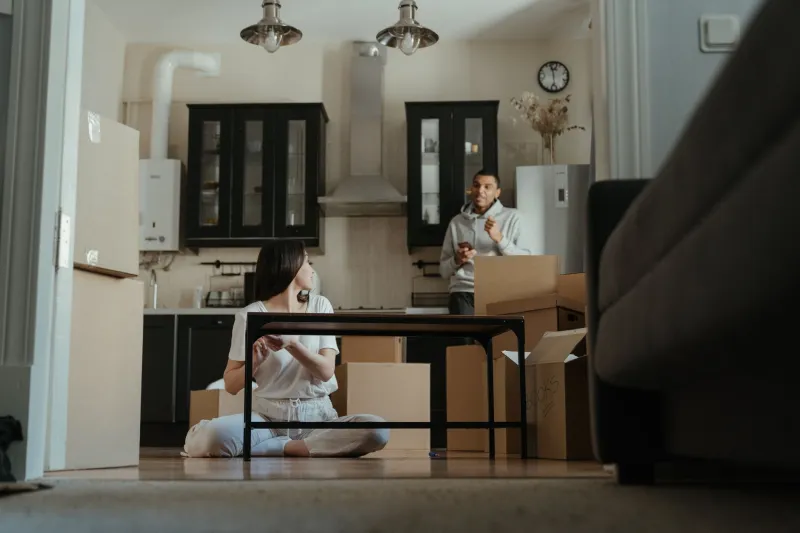
You both had lives before this. Good lives, actually — with apartments you'd carefully furnished, art you'd hunted down at flea markets, and sofas that had seen you through some serious Netflix marathons. That stuff meant something. And now it's all piled into one space, competing for square footage, and suddenly nothing looks right.
Welcome to one of the quieter challenges of merging households: the "but I love that lamp" conversation. It sounds minor. It rarely is.
The truth is, the pieces we hold onto from our solo lives carry emotional weight that has almost nothing to do with design. Your mid-century dresser isn't just a dresser — it's the first real furniture you ever bought yourself. His leather recliner isn't just a chair — it's where he sat when he got the job offer that changed everything. Asking someone to let go of those things without acknowledging what they represent is a recipe for resentment.
But here's the other truth: not everything deserves to come with you.
The Real Reason This Feels So Hard
When couples argue about furniture, they're rarely actually arguing about furniture. What's underneath it is usually something like: Does my taste matter here? Do my memories count? Am I being erased from this home?
Those are real fears, and they're worth naming out loud before you ever start measuring floor plans or comparing paint swatches. If one partner feels like their aesthetic is being steamrolled, no amount of compromise on throw pillows is going to fix that.
So before you make a single keep-or-toss call, sit down together — without the stuff in front of you — and agree on a few ground rules. Something like: We're building something new together, and both of us get to bring pieces of who we are into this home. But we're also allowed to outgrow things. That framing matters.
Start With Function, Not Feelings
Once you've had the emotional groundwork conversation, it actually helps to get practical first. Go room by room and figure out what you need — not what you have, but what the space genuinely requires to function.
Do you need a dining table? Yes. Do you need two dining tables? Almost certainly not. Do you need a desk? Depends on your work situation. A coffee table? Probably. Two sets of dish racks, four sets of sheets, and three different blenders? Hard pass.
When you look at what the home actually needs versus what you're both bringing to the table (literally), you'll often find that the decisions make themselves. Redundancy is the enemy of a cohesive space. If you have two of something and one clearly outperforms the other — in quality, size, or style — that's an easy call.
The harder calls come when both pieces are equally good but stylistically incompatible. That's where the real work begins.
The Three-Question Test
For every piece that's generating friction, try running it through these three questions together:
1. Does it work in the actual space? Not in theory. Not in the apartment it came from. In this room, with this layout, next to these other pieces. A statement sofa that anchored a 900-square-foot studio might overwhelm a cozy living room in a townhouse. Scale matters more than most people realize, and a piece that's wrong for the room will always feel wrong, no matter how much you love it.
2. Does it fit the home we're building — or the home we each had? This is the big one. There's a difference between a piece that genuinely reflects who you both are and a piece that's really just a placeholder from a previous chapter. If you're honest with yourself, some of what you're holding onto is less about the object and more about not wanting to feel like you've lost something in this transition. That's understandable. But it's worth separating attachment from actual love for a piece.
3. Can it evolve? Some pieces are more adaptable than they look. A solid wood dresser with dated hardware might just need new pulls. A perfectly good bookcase might just need a coat of paint. Before you write something off because it feels "too bachelor pad" or "too girly," ask whether a small intervention could bring it into the shared aesthetic. Sometimes the answer is yes, and that's actually a fun project to tackle together.
Give the Sentimental Stuff Its Due
Not everything can be evaluated purely on design merit, and that's okay. Some items are staying because they matter, full stop — and both partners should get a few of those cards to play.
Maybe it's the quilt your mom made. Maybe it's the record player he's had since college. Maybe it's a painting that makes no design sense whatsoever but makes you feel at home every time you look at it. These pieces deserve a spot, even if they don't fit a mood board.
The key is being intentional about how many of these "non-negotiables" each person gets, and then designing around them rather than against them. A beloved but visually chaotic piece can often be anchored with the right surrounding elements — a neutral wall color, complementary textures, enough breathing room so it doesn't feel cluttered.
What doesn't work is when every single item in the home is a non-negotiable. That's not a shared home — that's a storage unit with good lighting.
When Letting Go Is Actually a Gift
Here's something nobody tells you: releasing a piece of furniture can feel surprisingly freeing. There's something about voluntarily letting go of the old — the hand-me-down coffee table, the futon, the bookshelf held together with hope and a couple of L-brackets — that makes space for something new. Not just physically, but psychologically.
Choosing together what your home will look like is one of the first genuinely collaborative acts of building a life together. It's low-stakes enough that you can practice compromise and high-stakes enough that it actually matters. How you handle the "I love this chair but it doesn't work here" conversation is pretty good practice for harder conversations down the road.
And sometimes, the most loving thing one partner can do is say, I know you love that, and I'm willing to let it go so we can find something we both love even more.
A Note on Storage and Sentimentality
If something has real sentimental value but genuinely doesn't work in your home, don't force it — but don't dump it either. A storage unit, a parent's basement, or even a friend's spare room can be a temporary home for pieces you're not ready to part with permanently. Give yourself six months. If you haven't missed it or found a place for it by then, you probably have your answer.
The goal isn't to strip your home of personality or history. It's to create a space that feels like both of you chose it — not a compromise where nobody got what they wanted, but a genuine reflection of what you're building together. That's worth being a little ruthless for.